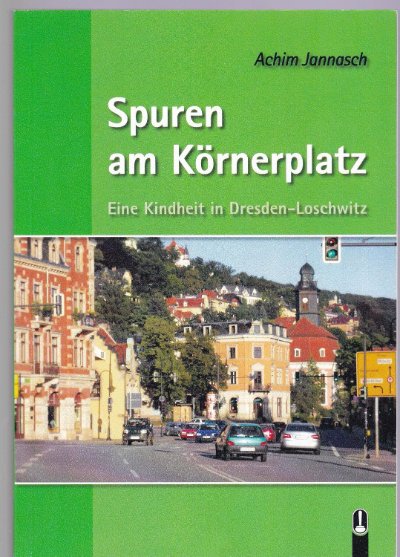
Spuren am Körnerplatz
Achim Jannasch
A childhood in Dresden-Loschwitz. Achim Jannasch recalls growing up around Körnerplatz.
View on Amazon
DEEN
The Ortsverein looks after local history and runs a peregrine falcon camera, the sports club keeps 450 people between 4 and 93 moving, and a winegrowers' association has brought vines back to the slope after a hundred-year break. Club life in Loschwitz has more substance than the size of the district suggests.
The club explicitly continues the Loschwitz Ortsverein of 1882 and grew out of the citizens' committees formed after 1989. Its stated aim is to preserve and carefully develop the cultural landscape of the Dresden Elbe slope.
It currently has 96 members and three honorary members; the annual subscription is 36 euros. The chairman is Norbert Richter, and the board comprises ten further people. The club has published several books on local history, among them the illustrated history for the 700th anniversary in 2015 with around 2,700 illustrations across 1,056 pages. Regular formats include benefit concerts in the Loschwitz district office and the Elbhang talks.
Since 2014 the Ortsverein has looked after the tower of the old fire station. A pair of peregrine falcons nests there and can be watched on a live camera. That is the kind of project you would not immediately expect from a local heritage society.
Around 450 members between the ages of 4 and 93 are active. The club offers four sections: football, skittles, table tennis and gymnastics. The age range is not a marketing figure but describes a structure in which children's football and seniors' gymnastics run under the same roof.
The founding followed a resolution of 1 February 1984 that set in motion the replanting of 140 hectares over ten years. Clearing work began in the summer of 1986, and a year later 38 interested people founded the association.
Today it is a non-profit association with 36 members, most of whom also belong to the Saxon winegrowers' cooperative in Meissen. Fourteen growers tend plots at Lingner Castle in Loschwitz, fourteen on the Wachwitz vineyard, and ten have parcels of their own. Six members have their vines in Loschwitz, thirty in Wachwitz, and one works full-time as a winegrower. The average age is around 53.
Since October 1992 the wines from the area between Pirna and Diesbar-Seußlitz have officially been called Saxon wine rather than Meissen wine.
The Elbhangfest takes over the stretch between the Blaues Wunder in Loschwitz and Pillnitz Castle. It is organised by a non-profit association. In peak years it drew around 80,000 visitors. The first edition took place in the early 1990s; the numbering of the anniversary editions suggests 1991 as the starting year, while English-language sources also give 1990.
For Loschwitz the weekend means a state of exception. Pillnitzer Landstraße becomes a festival mile, stages stand in gardens and backyards, and the hill railways run a special service.
More on its history, the festival mile and getting there on the Elbhangfest page. Official site: elbhangfest.de
The parish uses the church built by George Bähr and reconsecrated in 1994. Alongside services, concerts shape the programme, helped by the Wegscheider organ of 1997 with its 20 stops. The parish was a major force behind the rebuilding after 1991.
Since the reopening in 2005 the foundation has looked after the Schillerhäuschen at Schillerstraße 19 on a voluntary basis. It is not a purely Loschwitz institution but has taken on a permanent task here.
Loschwitz was an independent municipality until 1921 and resisted incorporation. The Ortsverein of 1882 was part of that self-government. The immediate refounding of an Ortsverein in 1991 has to do with that history, and the wording in the club's purpose about careful development should be read as a position on building projects.
The division of labour is striking. The Ortsverein handles history, publications and planning issues, the Elbhangfest public visibility, the winegrowers' association the cultural landscape on the slope, and the sports club everyday life. Four clubs, four clearly separated tasks, in a district you can cross in twenty minutes.
Anyone newly arrived and looking for contact has several low-threshold options. The Ortsverein's Elbhang talks are open, as are the benefit concerts in the district office. At SV Loschwitz, skittles and gymnastics have the lowest barrier to entry. The Elbhangfest looks for helpers every year for the weekend in June, and that work brings you into contact with half the district faster than any club meeting.
36 euros a year. The club is financed by subscriptions and donations.
Yes. The club describes itself as open to all age groups; the oldest active member is 93. Skittles and gymnastics are particularly suitable for late starters.
The association is a non-profit body with 36 members at present. Enquiries go through the association itself; free plots are scarce.
On the tower of the old fire station, looked after by the Ortsverein. Viewing is via a live camera; the nest itself is hard to see from the ground.
Very probably. This list names only clubs whose details can be publicly documented. Tips about missing clubs are welcome, via the contact in the legal notice.
Advertisement
Two books for anyone who wants to read more about Loschwitz and Dresden. Both are in German.
Achim Jannasch
A childhood in Dresden-Loschwitz. Achim Jannasch recalls growing up around Körnerplatz.
View on Amazon
Kevin R. Hoff
A full-colour travel guide to the whole city, for everything beyond Loschwitz.
View on Amazon