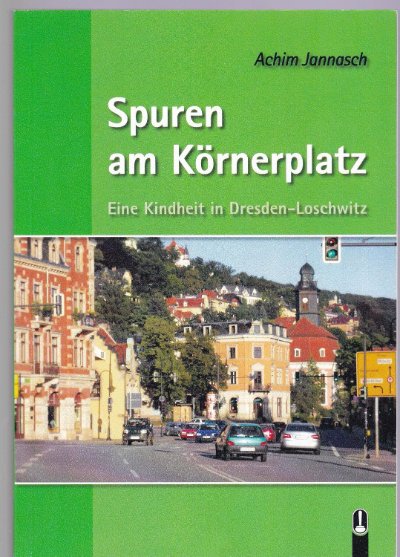
Spuren am Körnerplatz
Achim Jannasch
A childhood in Dresden-Loschwitz. Achim Jannasch recalls growing up around Körnerplatz.
View on Amazon
DEEN
Loschwitz is considered one of the most sought-after residential areas in Dresden: the Elbe slope, villas, a preserved village core and the Dresden Heath on the doorstep. Anyone thinking of living here quickly runs into a confusion. Loschwitz is both a small quarter and a large city district. This page sorts out the two and collects what matters for everyday life.
The quarter of Loschwitz is the old village on the right bank of the Elbe between the Saloppe and Wachwitz, with Körnerplatz, the church and the slope. It borders the Radeberger Vorstadt, Weißer Hirsch, Bühlau, Rochwitz, Wachwitz and the Dresden Heath. The Blaues Wunder bridge links it with Blasewitz.
The Loschwitz city district is much larger. According to the city of Dresden it comprises the quarters of Loschwitz, Weißer Hirsch, Rochwitz, Wachwitz, Niederpoyritz, Hosterwitz, Söbrigen, Oberpoyritz, Bühlau, Pillnitz and the Dresden Heath. Until 2018 it was called an Ortsamtsbereich. That is why Pillnitz Castle is sometimes counted as part of Loschwitz, although it lies six kilometres upstream.
| Item | Value |
|---|---|
| Residents with main residence | 20,570 |
| Area | 6,880 hectares |
| Population density | about 300 residents per square kilometre |
| Quarters | 10 plus the Dresden Heath |
| Postcodes | 01326, 01324 and 01099 (according to Wikipedia) |
A good two thirds of the area is taken up by the Dresden Heath, where almost nobody lives. That explains the low density even though the slopes are densely built. In the city's statistics Loschwitz and Wachwitz together form one statistical quarter.
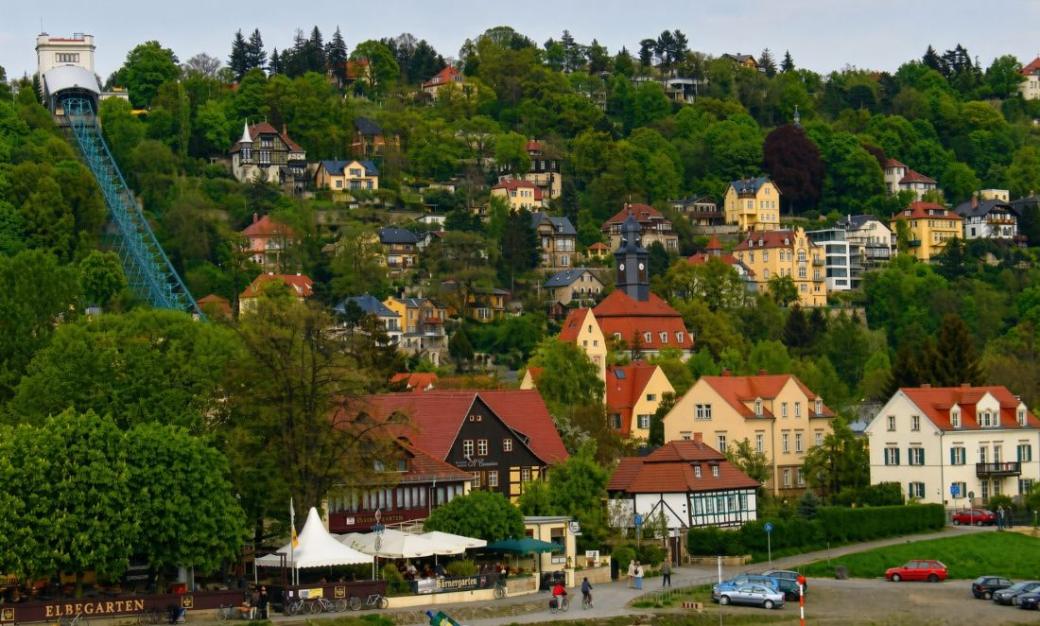
By the water lies the old village core around Friedrich-Wieck-Straße and Körnerplatz. The city of Dresden counts it among the largest surviving "villages in the city" and restored it as a redevelopment area. The houses are small, often listed, with shops and cafés on the ground floor.
On the slope come the villas built between 1880 and 1925, many of them listed monuments. Anyone building or renovating here needs the heritage authorities on side. Above the crest begin Oberloschwitz and Weißer Hirsch, the former spa quarter with the Lahmann sanatorium of 1888. It is flatter up here and the heath is within walking distance.
For the whole city district the city of Dresden lists five primary schools, three secondary schools, one grammar school and one vocational school, plus 16 child and youth welfare facilities. The figures date from the start of the 2019/2020 school year. Which school serves a particular address and which nurseries have places can be answered by the city's school administration office and its municipal childcare provider.
The hill railways are not just an attraction but part of the Dresden transport company's public network. Residents on the slope ride the funicular or suspension railway down to Körnerplatz and change to the bus there. The city centre is reached via Blasewitz or along Bautzner Straße. By bike the Elbe cycle path is the quickest route; uphill it becomes hard work. More on the getting here page.
Parking is scarce in the old village core, and many streets on the slope are narrow and steep. In winter that can become a problem.
The streets near the river were under water in 2002 and 2013, including the Loschwitz cemetery on Pillnitzer Landstraße. If you are looking for a flat in the lower village, check its position relative to the Elbe and consult the city's flood hazard maps. On the slope and up on the crest this plays no part.
The Loschwitz district office is at Grundstraße 3 in the village core. The district advisory council meets there to discuss the district's affairs. Anyone who wants to get involved locally will find a place in the Ortsverein Loschwitz-Wachwitz and the other clubs and associations.
According to the city of Dresden, the Loschwitz city district has 20,570 residents with their main residence there. The quarter of Loschwitz itself is much smaller and is recorded statistically together with Wachwitz.
Loschwitz, Weißer Hirsch, Rochwitz, Wachwitz, Niederpoyritz, Hosterwitz, Söbrigen, Oberpoyritz, Bühlau, Pillnitz and the Dresden Heath.
The quarter of Loschwitz has the postcode 01326. Weißer Hirsch has 01324, and some addresses on the western Elbe slope, such as the Elbe castles, have 01099.
At Grundstraße 3, 01326 Dresden, in the old village core near Körnerplatz.
Advertisement
Two books for anyone who wants to read more about Loschwitz and Dresden. Both are in German.
Achim Jannasch
A childhood in Dresden-Loschwitz. Achim Jannasch recalls growing up around Körnerplatz.
View on Amazon
Kevin R. Hoff
A full-colour travel guide to the whole city, for everything beyond Loschwitz.
View on Amazon