Spuren am Körnerplatz
Achim Jannasch
A childhood in Dresden-Loschwitz. Achim Jannasch recalls growing up around Körnerplatz.
View on Amazon
DEEN
Once a year, on the last weekend in June, the Elbe slope between Loschwitz and Pillnitz becomes a festival mile. About seven kilometres along Pillnitzer Landstraße, five villages, concerts in churches, stages in gardens and courtyards. The Elbhangfest is one of Dresden's largest street festivals and is run by a volunteer association.
The 33rd Elbhangfest took place from 26 to 28 June 2026 under the motto "Rockt den Weber! – Carl Maria zum 240. Geburtstag" (Rock the Weber, for Carl Maria von Weber's 240th birthday). The programme listed more than 200 events at 85 venues, with free admission. One highlight was the light show "Weber leuchtet" on the facade of the Weber Museum in Hosterwitz. By tradition the 34th Elbhangfest will follow on the last weekend in June 2027. The association publishes the date, programme and venues each early summer at elbhangfest.de.
It started with two churches. George Bähr's church in Loschwitz had been a ruin since 1945, and the Weinbergkirche in Pillnitz had suffered badly over decades. Residents set up benefit initiatives for both buildings, and in November 1990 a group of Elbe slope residents met Matthias Griebel, then director of the city museum, to discuss a joint festival. The first Elbhangfest took place on 29 and 30 June 1991 under the motto "Von Bähr zu Pöppelmann" (from Bähr to Pöppelmann). On the first day the foundation stone for rebuilding the Loschwitz church was laid, on the second the restored tower ball was placed on the Weinbergkirche.
It was planned as a one-off. Some of the organisers already had experience with smaller festivals on the slope, such as the Gullyfest, the Wachwitz well festival and the wine festival. The response was so strong that it became a fixture.
For the second festival in 1992 a non-profit association was founded, which has run it ever since. The churches long remained the focus: at the third festival in 1993 the tower ball was placed on the Loschwitz church, and it was reconsecrated in 1994.
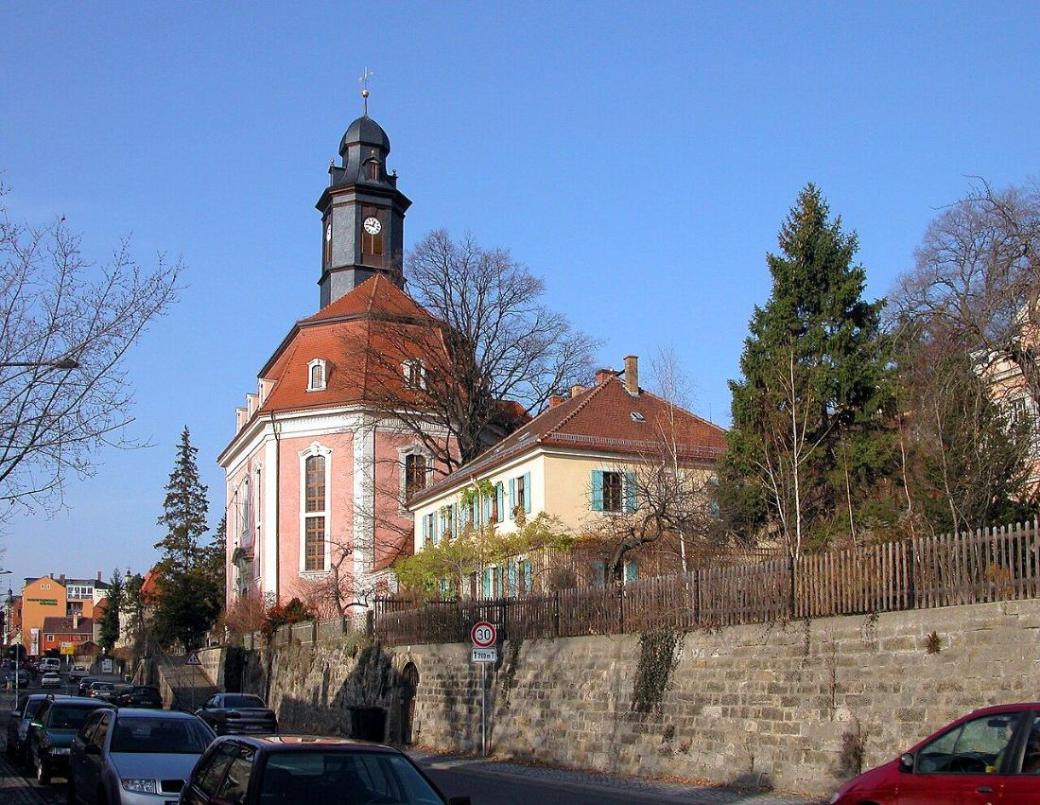
The festival grounds stretch from Körnerplatz in Loschwitz to the palace gardens at Pillnitz, marked by the George Bähr church at one end and the Weinbergkirche at the other. In between lie Wachwitz, Niederpoyritz and Hosterwitz. Key spots are the rhododendron garden and the wine villages, where winegrowers from the Elbe slope pour their wines.
In Loschwitz the festival begins in the village core by the Blaues Wunder bridge, and a promenade leads to the wine village with the craft market. Regular participants include the Keyserlingk vineyard on Veilchenweg, the Hegenbarth Archive and the Elbhang-Kurier publishing house. On the village square in Wachwitz stands the historic well house, the festival's poster motif in 2026, with a stage and wine bar. The second wine village is at Pillnitz Castle.
Private gardens are typical of the festival. Along Pillnitzer Landstraße residents open their grounds, serve drinks, play music or exhibit. Add to that concerts in the three Elbe slope churches, exhibitions by the local history associations, guided walks, theatre, readings, an art market and activities for children.
The festival includes a parade that takes up the motto each year. In 2002 one of its highlights was the "bell procession", recalling the link between the two baroque churches.
Each festival has a theme, often linked to people or history of the Elbe slope. A selection:
| Year | Motto |
|---|---|
| 1991 | Von Bähr zu Pöppelmann |
| 2000 | Wachwitz zeigt die Zehne – 650 Jahre Wachwitz – 10 Jahre Elbhangfest |
| 2002 | Kneippen, Kuren und L’Amouren |
| 2026 | Rockt den Weber! – Carl Maria zum 240. Geburtstag |
In 2002 the theme was the spa tradition of the Elbe slope from Lahmann to Bilz, with drinking fountains in all five villages. In 2026 the focus was Carl Maria von Weber, who spent his summers in Hosterwitz. As a cross axis to the festival mile, the trail "Auf dem Weg zu Weber" led from the church Maria am Wasser up into the Keppgrund valley.
On the festival weekend many streets in and between Loschwitz and Pillnitz are closed. The festival area used to be closed to cars entirely. Because of security requirements Pillnitzer Landstraße now stays open; in 2025 a 30 km/h limit applied, in 2026 20 km/h. The association still asks visitors to leave the car at home. There is practically no parking. The best way is by bus or tram to Körnerplatz or Pillnitz, by bike along the Elbe cycle path, or on foot across the Blaues Wunder bridge.
Every year on the last weekend in June. The 33rd festival took place from 26 to 28 June 2026.
Along about seven kilometres of Pillnitzer Landstraße between Körnerplatz in Loschwitz and the palace gardens at Pillnitz, with Wachwitz, Niederpoyritz and Hosterwitz in between.
Since 29 and 30 June 1991. It grew out of benefit initiatives for rebuilding the Loschwitz church and preserving the Weinbergkirche in Pillnitz.
The volunteer association Elbhangfest e.V., supported by residents, artists, local restaurants, the Loschwitz district office and the city of Dresden.
By bus or tram, by bike, or on foot across the Blaues Wunder bridge. Many streets are closed and there is hardly any parking.
Advertisement
Two books for anyone who wants to read more about Loschwitz and Dresden. Both are in German.
Achim Jannasch
A childhood in Dresden-Loschwitz. Achim Jannasch recalls growing up around Körnerplatz.
View on Amazon
Kevin R. Hoff
A full-colour travel guide to the whole city, for everything beyond Loschwitz.
View on Amazon