Funicular and Suspension Railway in Loschwitz
Loschwitz has two historic hill railways in a small area. The funicular has run from Körnerplatz up to the Luisenhof since 26 October 1895, the suspension railway to Oberloschwitz since 6 May 1901. Both belong to the Dresden transport company, both are listed monuments, and the suspension railway is regarded as the oldest mountain suspension railway in the world.
The reason for two railways lies in the terrain. Almost a hundred metres of altitude separate the riverbank from the crest of the slope, and at the end of the nineteenth century prosperous housing was growing above while the bridge and the steamers arrived below. Anyone wanting to sell plots on the hillside needed a connection. The funicular came first; six years later the technically more unusual solution followed.
The funicular
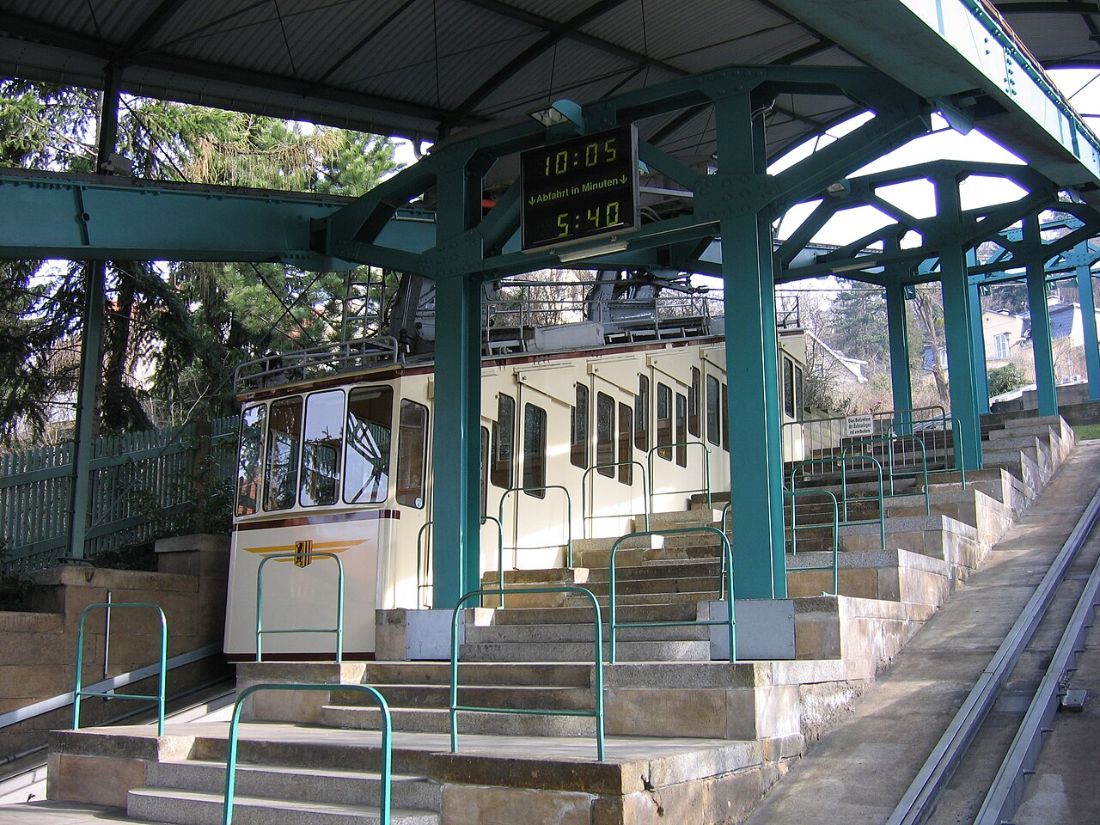
It began operating on 26 October 1895, at first with steam power. In 1909 it was converted to electric operation, and in 1932 an overhead line was added. The line is 547 metres long, metre gauge at 1,000 millimetres, climbs around 95 metres and reaches a maximum gradient of 29.8 per cent. A journey takes five minutes.
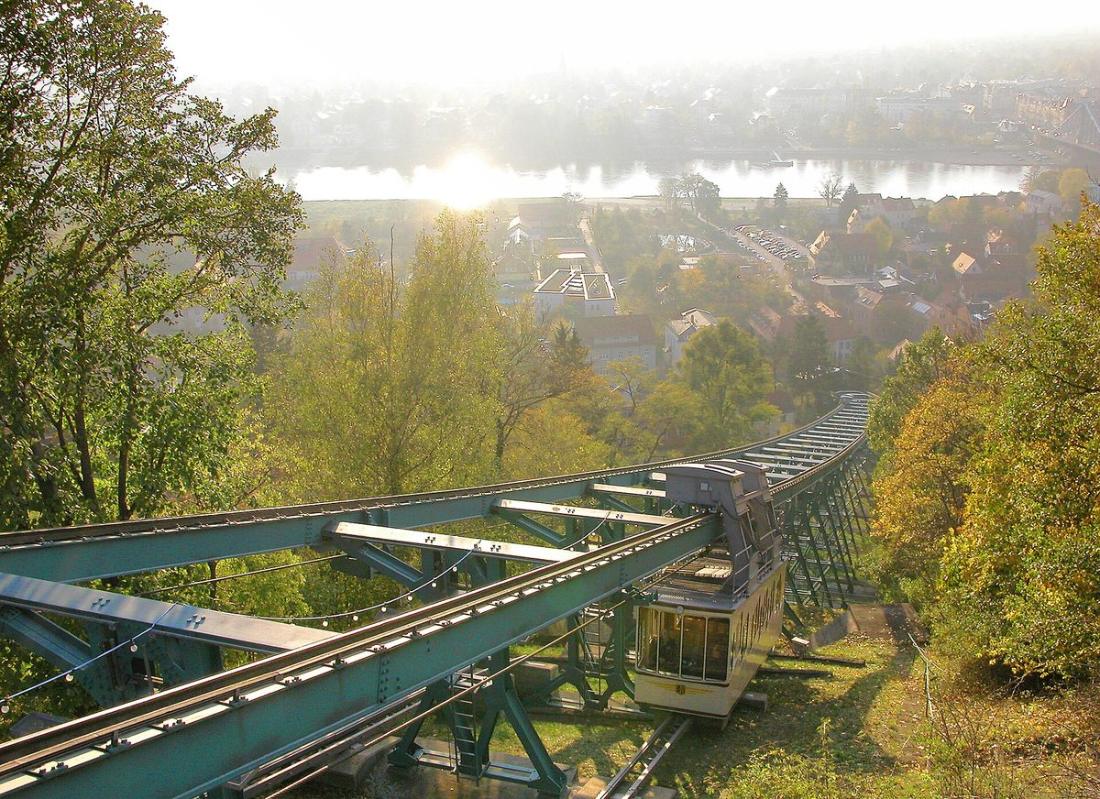
Three structures are packed into those 547 metres: the 96-metre Burgberg tunnel, a 102-metre trestle viaduct with the passing loop where the two cars meet, and the 54-metre Prinzeß Louisa tunnel. The alternation of darkness and light is the real appeal of the ride.
The railway has been a listed monument since 1984. It was overhauled in 1978 and 1979, modernised after reunification in 1994, and thoroughly renewed again for its 125th anniversary in 2020 and 2021. In 2014 some 350,000 passengers used the line.

The suspension railway
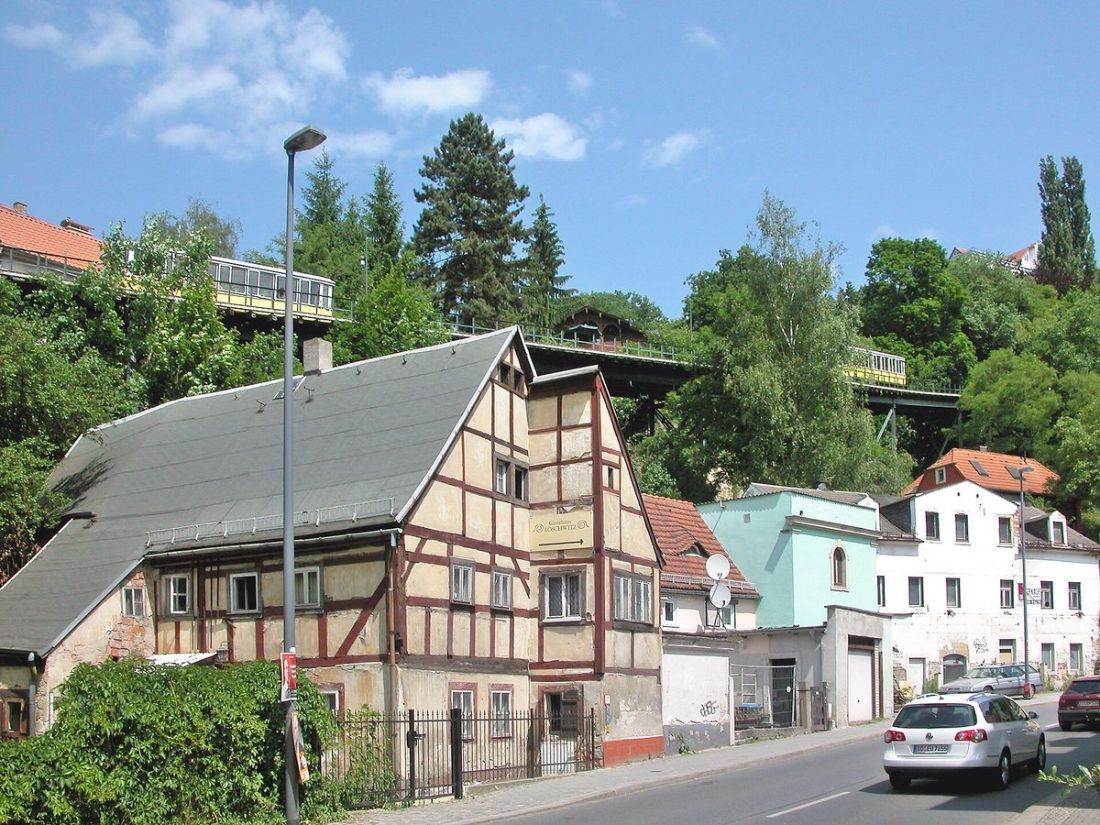
Opened on 6 May 1901, it was built on the Eugen Langen system otherwise known from the Wuppertal suspension railway. In Dresden it became something different: the cars do hang from a rail, but they are moved by a haulage rope as on a funicular. That makes the installation the only hanging railway in the world that is not an adhesion railway.
The line measures 273.8 metres and climbs 84.2 metres. The average gradient is 32.18 per cent, the maximum 39.9 per cent. The haulage rope is 38 millimetres in diameter. The valley station at Körnerplatz lies at 124 metres above sea level, the upper station in Oberloschwitz. A journey now takes 4.5 minutes; in 1986 it was three.
In 1909 a direct-current motor replaced the steam engine. Between 1984 and 1992 the installation was fundamentally rebuilt, partly with helicopter assembly, because the frame could not be reached any other way. Repairs and the rebuilding of the upper station followed in 2001 and 2002, and in 2013 the large drive wheel was replaced. The railway has been a listed monument since 1975, and in 2007 it was nominated as a Historic Landmark of Engineering in Germany.
The two railways compared
| Feature | Funicular | Suspension railway |
|---|---|---|
| Opened | 26 October 1895 | 6 May 1901 |
| Length | 547 metres | 273.8 metres |
| Height gained | around 95 metres | 84.2 metres |
| Maximum gradient | 29.8 per cent | 39.9 per cent |
| Journey time | 5 minutes | 4.5 minutes |
| Upper station | Luisenhof | Oberloschwitz |
| First electrified | 1909 | 1909 |
| Listed since | 1984 | 1975 |
| Operator | Dresdner Verkehrsbetriebe | Dresdner Verkehrsbetriebe |
Check before you travel
Timetables, fares and maintenance closures change. Both railways are taken out of service for several weeks at a time on a regular basis. Current information is published by the Dresdner Verkehrsbetriebe, where the hill railways have their own section. This site deliberately omits prices, because they date quickly.
Which railway should you take?
If you are after the view, take the funicular. At the top, the Luisenhof has a viewing terrace looking out over the Elbe valley, with the Blaues Wunder squarely in the picture. If you want to see the machinery, take the suspension railway. The drive mechanism is accessible in the Oberloschwitz upper station, and the ride itself gives an unfamiliar view across the rooftops.
The two combine well. The valley stations are a few minutes' walk apart, and a path along the crest of the slope connects the two upper stations. Walking the whole circuit takes about an hour and a half with breaks.
Why two railways were built here of all places
The 1890s were Dresden's decade of development. In 1893 the bridge was in place, and suddenly the right bank of the Elbe was within reasonable reach of the city. Plots on the slope rose in value, villas and guesthouses went up above, and Weißer Hirsch developed into a spa resort. Anyone investing there had an interest in guests and residents not having to climb a hundred metres on foot.
The funicular of 1895 was the obvious solution, because the technology had already proved itself in the Alps. The suspension railway of 1901 was the opposite of obvious. The Eugen Langen system was known from Wuppertal, where it was used above a river. In Dresden it was transferred to a hillside and combined with a rope drive. The result is an installation that exists in this form nowhere else in the world.
That both railways still run is not a matter of course. Comparable installations in other German cities were closed and dismantled between the wars or in the 1960s. In Dresden they survived both wars, the GDR era and the backlog of repairs that followed. Between 1984 and 1992 parts of the suspension railway were assembled by helicopter, because the frame on the slope could not be reached otherwise.
What there is to see on a ride
The drive technology of the suspension railway is accessible in the Oberloschwitz upper station, including the large wheel replaced in 2013. Anyone interested in mechanical engineering should allow time at the top rather than getting straight back in.
With the funicular the appeal is on the line. After the Burgberg tunnel the view opens out on the trestle viaduct, where the two cars pass each other at the loop, and then the Prinzeß Louisa tunnel swallows the train again. At the top the Luisenhof has a viewing terrace from which the Blaues Wunder and the Elbe valley lie in full view.
Frequently asked questions about the hill railways
Is a normal VVO ticket valid on the hill railways?
The railways belong to the Dresdner Verkehrsbetriebe but have their own fare rules, which may differ from the city lines. Check with the DVB before boarding which tickets are accepted.
Is the suspension railway really the oldest in the world?
As a mountain suspension railway, yes. The Wuppertal suspension railway entered service in the same period, but it runs on the level above the river Wupper and is a pure hanging railway. The Dresden installation climbs a hillside and is moved by a haulage rope. In that category it is the oldest in the world.
How do you reach the valley stations?
Both are within walking distance of Körnerplatz, which is reached across the Blaues Wunder and by the bus lines. Details are on the travel page.
Are the railways accessible?
Both are historic installations with structural limitations. Accessibility differs by station and was only partly improved during the restorations. If you depend on step-free access, clarify it in advance with the transport company.
Can you walk the routes instead?
Paths run up the slope alongside both lines. Allow 20 to 30 minutes for the climb depending on your pace; it is almost a hundred metres of ascent in one go.