Sights in Loschwitz
The well-known destinations in Loschwitz can be counted on two hands: the bridge, two hill railways, the church, three museums, three Elbe castles. It gets interesting with what stands beside them. A mausoleum by Hans Poelzig, an observatory built for Manfred von Ardenne, a fire station tower with peregrine falcons, and a churchyard of 400 square metres that is among the smallest surviving in Saxony.
The Loschwitz church by George Bähr
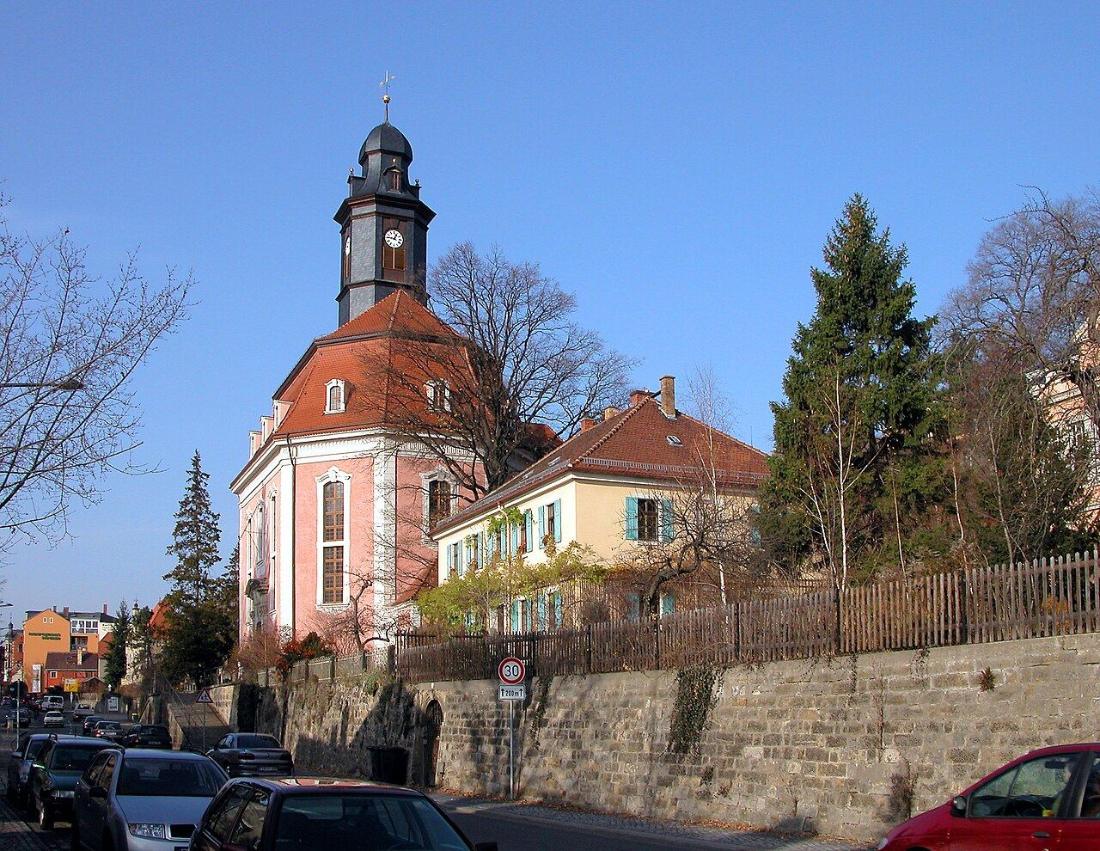
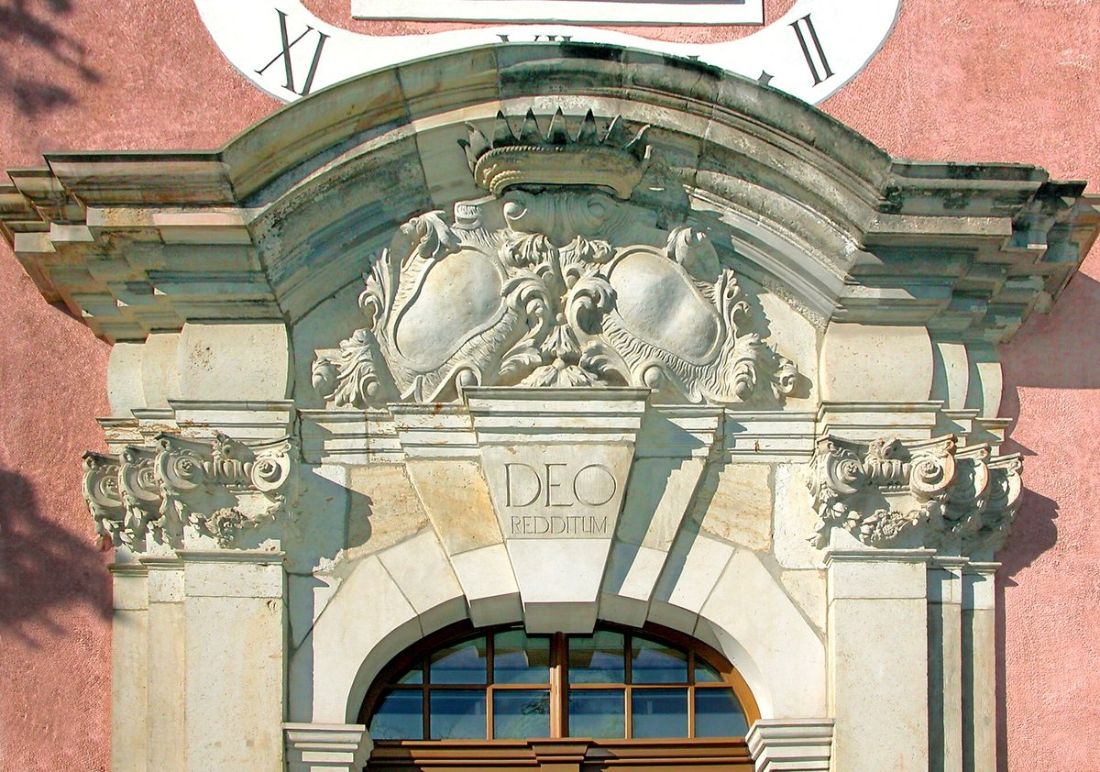
George Bähr, who later built the Frauenkirche, designed the Loschwitz church in 1704. Construction began on 27 April 1705, the foundation stone was laid on 29 June, and the consecration took place on 3 August 1708. The result is an octagonal baroque building, 27.7 metres long, 16.3 metres wide and 41.5 metres high, with a mansard roof and a bell-shaped dome. It originally held 820 people.
The colour is striking. The facade is painted old rose, unusual for a Saxon village church and deliberately reconstructed during the rebuilding. In the bombing raid on the night of 13 to 14 February 1945 the building burned out, leaving only the outer walls. Reconstruction began in 1991 and the church was reconsecrated on 2 October 1994. Structural weaknesses of the original design were corrected in the process.
The present organ was built by Kristian Wegscheider and consecrated on 5 October 1997. It has 20 stops on two manuals. Its predecessors, by Leibner in 1753 and by Jehmlich in 1899, both burned in 1945. Since 2002 the interior has held the Nosseni altar, which came from the destroyed Sophienkirche and so preserves a piece of central Dresden in Loschwitz.
The Blaues Wunder bridge
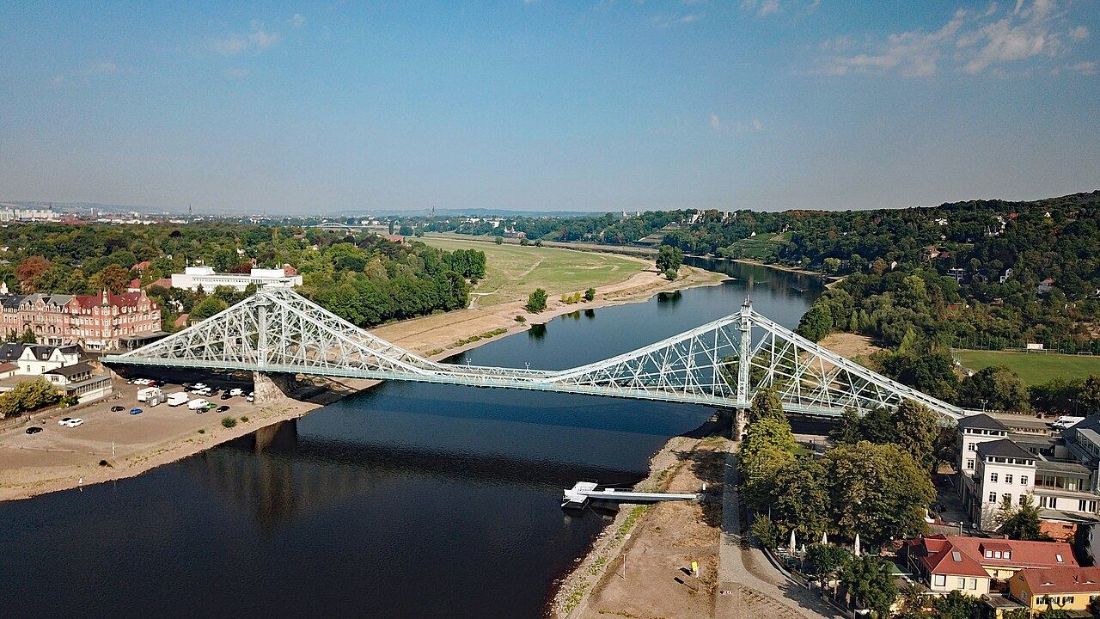
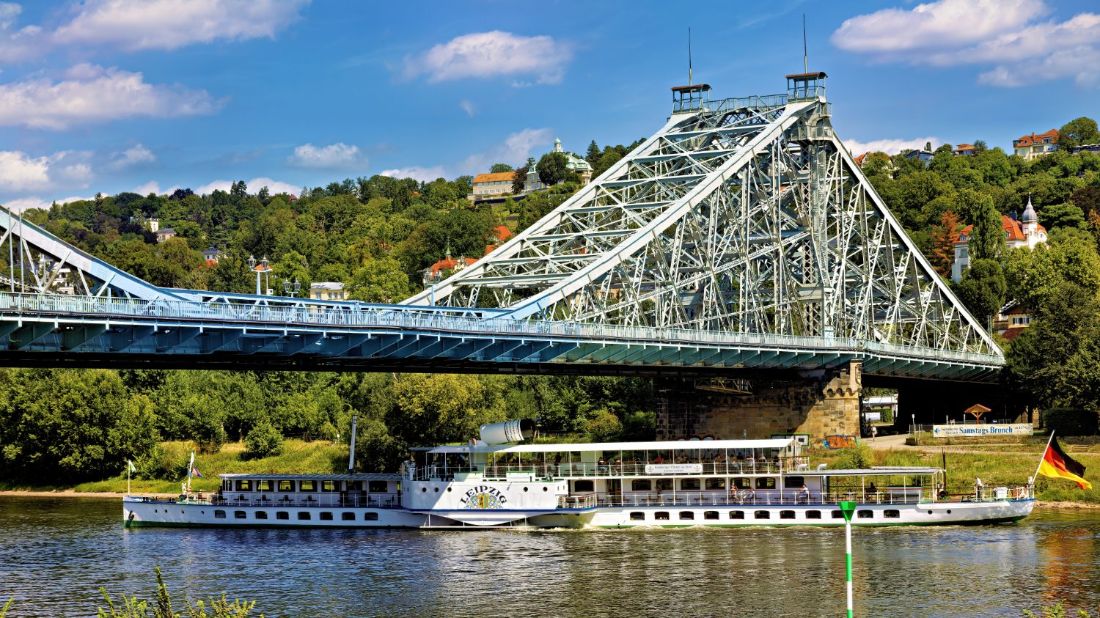
The Loschwitz bridge has linked Blasewitz and Loschwitz since 1893. Construction started on 28 April 1891 and the bridge was inaugurated on 15 July 1893: two years of work, 2.25 million gold marks, officially the King Albert Bridge after the Saxon king. Structurally it is a cantilever bridge, considered daring at the time. The nickname refers to the blue paint, to the engineering feat and to the German idiom about experiencing a "blue wonder" when something goes wrong. Contemporaries thought a collapse likely.
In 1945 the bridge came close to being blown up. An SS unit had placed the charges; two men cut the ignition cables. That is why the structure survives in its original form, which has since become a problem: its age forces traffic restrictions. Until the Waldschlößchen bridge opened on 26 August 2013, the Blaues Wunder was the only Elbe crossing east of the city centre.
The three Elbe castles
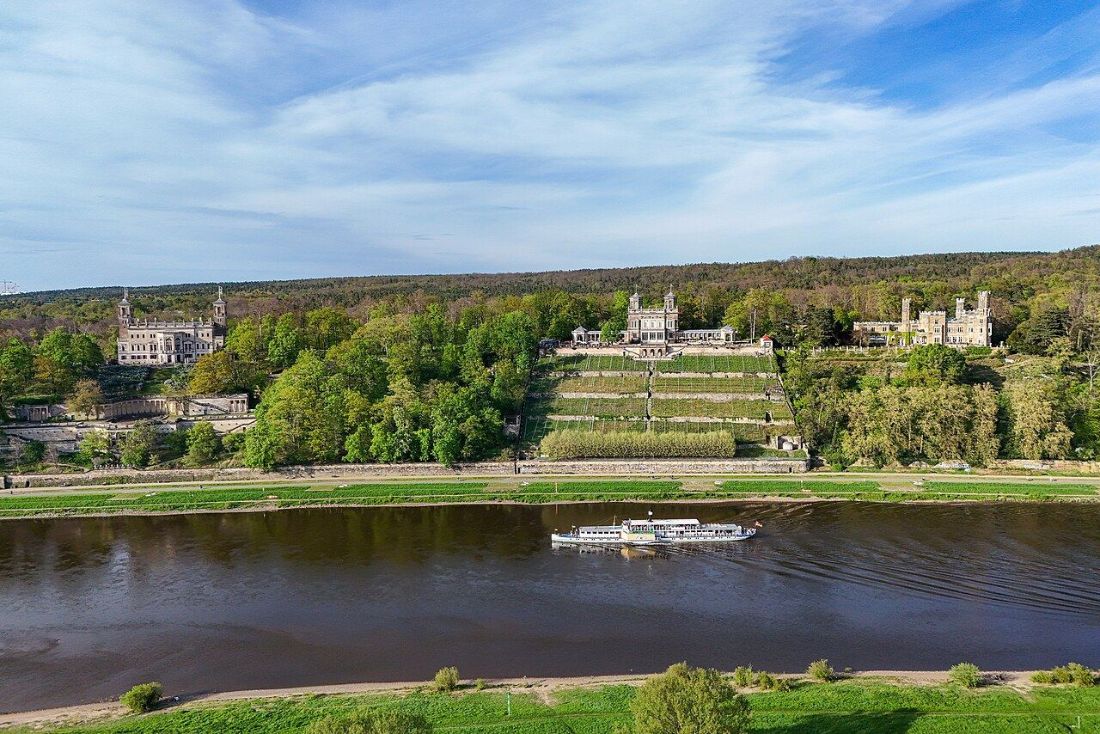
Between the Mordgrund bridge and the Saloppe, three castles stand in a row on Bautzner Straße, all on the right bank of the Elbe in the Loschwitz district. They were built within eleven years, between 1850 and 1861, on one and the same estate: until 1832 this was the Findlater vineyard, assembled from 1803 by the Scottish nobleman James Ogilvy, 7th Earl of Findlater. After his death in 1811 the land was divided and sold on several times. Each of the three parts now carries a castle.
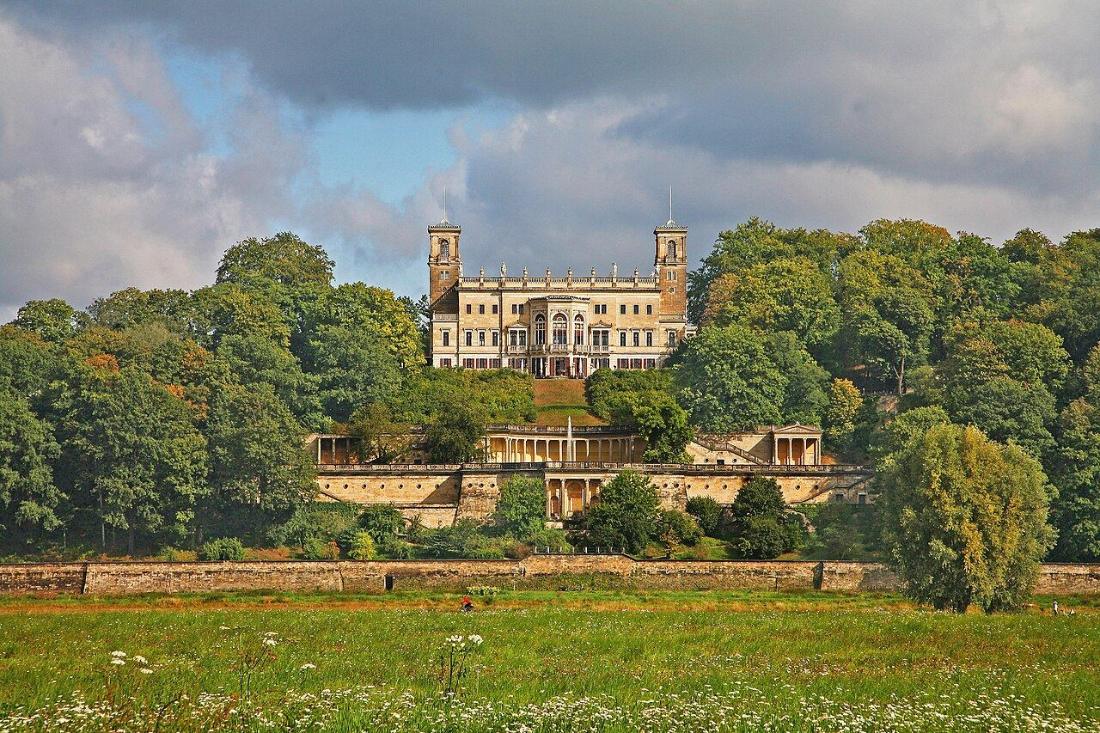
Schloss Albrechtsberg
It was commissioned by Prince Albert of Prussia, 1809 to 1872, the youngest brother of Frederick William IV and William I. He was no longer welcome at the Berlin court: he had separated from Marianne of Orange-Nassau and on 5 June 1853 married Rosalie von Rauch morganatically, she being raised to Countess of Hohenau before the wedding. The ceremony took place outside Prussia. Dresden was the fallback.
Adolf Lohse built on the foundations of a demolished coffee house which, from 1821, had been a popular destination known as Findlater's vineyard, its guests including Richard Wagner and Gottfried Semper. The late neoclassical building follows the tradition of Karl Friedrich Schinkel and is the grandest of the three. In 1925 the Counts of Hohenau sold the estate to the city of Dresden. The destruction of 1945 passed it by. It then housed the Soviet military administration, later a hotel, and until 1990 the Pioneer Palace. Today the city uses it for culture and events; the park and terraces are open.
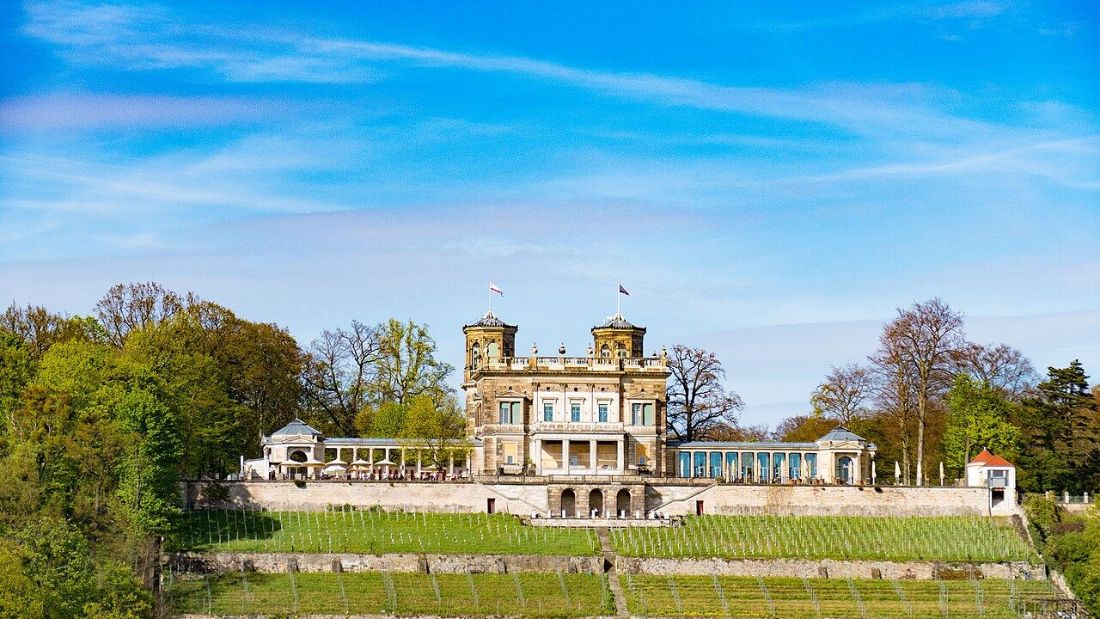
Lingner Castle, properly Villa Stockhausen
The middle of the three went up alongside its neighbour and by the same architect. It was intended as a home for Baron von Stockhausen, the prince's chamberlain. Until Albrechtsberg was finished, Albert lived in it himself. In 1891 the sewing machine manufacturer Bruno Naumann bought the villa and had it remodelled.
In 1906 Karl August Lingner acquired the estate, the marketer of Odol mouthwash and founder of the Hygiene Museum. He had a private inclined lift built from the valley up to the house, its upper station and track still visible, laid out a small zoo, and had an organ constructed whose sound could be transmitted to friends by telephone. The interiors were designed by Wilhelm Kreis with the painter Franz von Stuck.
In his will of 22 May 1916, drawn up two weeks before his death, Lingner left the estate to the city of Dresden with two conditions: free public access to the park and to the whole building, and a café or restaurant in the main house with the lowest prices in the area. He was buried in 1921 in the mausoleum in the park. The house came through 1945 undamaged and served as a military hospital, a Soviet commandant's office and a hostel. In 1957 the Club of the Intelligentsia moved in, co-initiated by Manfred von Ardenne. From 1993 it stood empty and decayed; restoration has been under way since.
Schloss Eckberg
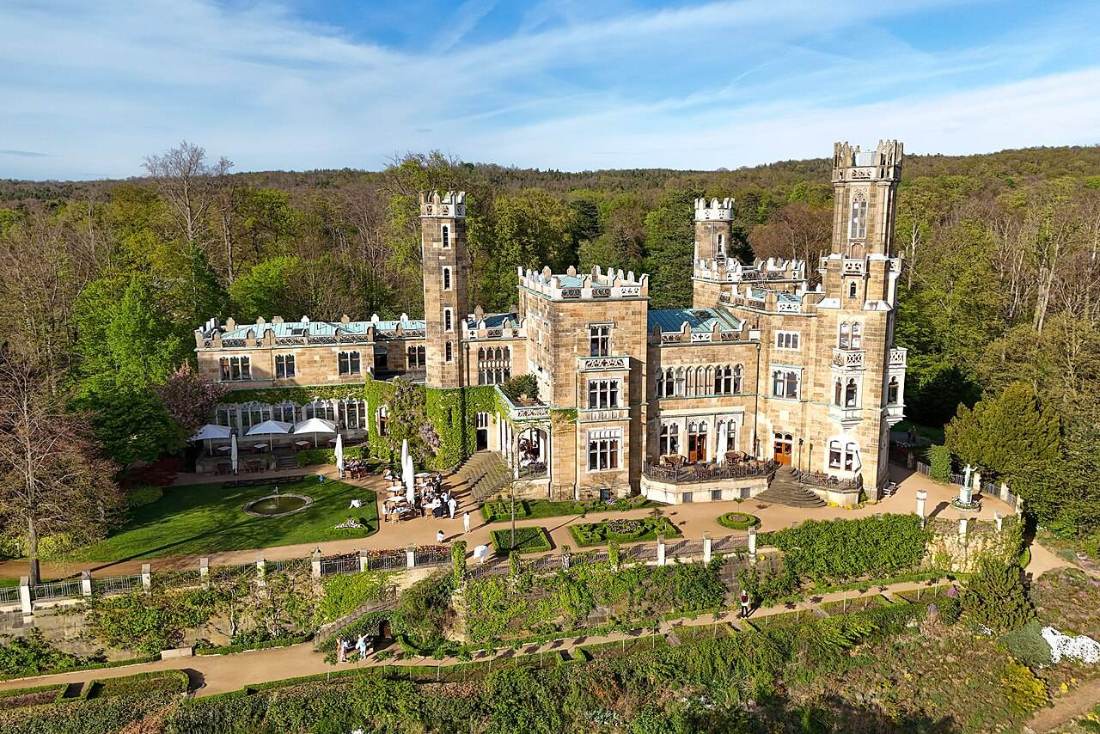
The easternmost of the three is the only neo-Gothic one. It was commissioned by the merchant Johann Daniel Souchay, who had made his fortune in the Manchester textile trade and put part of it into charitable foundations in Loschwitz. Christian Friedrich Arnold, a pupil of Semper, erected the richly articulated building on the site of a Klengel country house of 1675, taking English Tudor-style country seats as his model. The 15-hectare landscape garden was laid out by the court gardener Hermann Sigismund Neumann, who had already designed the gardens of Albrechtsberg and Villa Stockhausen.
In 1883 consul general Bruno Wunderlich bought the estate. His widow let it to the confectionery exporter Josef Weiser, whose wife later became known as the actress Grethe Weiser, and around 1920 to the opera singer Tino Pattiera. In 1925 Ottomar Heinsius von Mayenburg took over, inventor of Chlorodont toothpaste and a trained botanist: the rock garden and the tulip and crocus meadows go back to him. The castle now houses a hotel; the park remains open.
The Saloppe
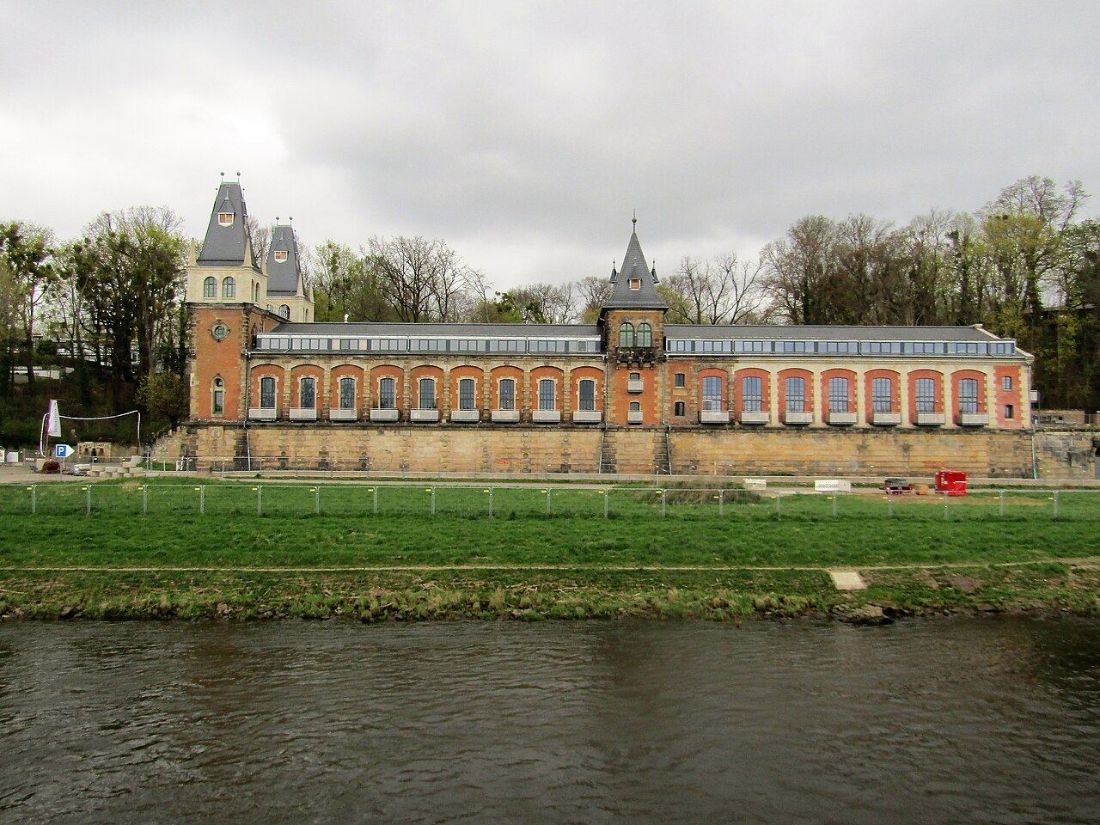
Below Schloss Albrechtsberg, in the sharp angle between Brockhausstraße and Körnerweg, stands Dresden's first drinking water works. It went into service in 1875. The site lies within the Loschwitz cadastral district but is counted statistically as part of the Radeberger Vorstadt, which is why local guidebooks tend to leave it out.
The name comes from the military. During the Seven Years' War Prussian soldiers put up a wooden field post here, which a ferryman and his wife kept on as a tavern after the army withdrew. In 1813 a Cossack post was quartered in it; Russian soldiers called the shack Wutki Chalupka, a schnapps hut. From chalupka, roughly "hut" in German, came Schaluppe and finally Saloppe. The wooden building was pulled down in April 1822 and replaced, and when the city of Dresden bought the plot in 1864 for the water works, that building went too. The name stayed and passed to the water works.
Drinking water has not come from here for a long time. Since 1995 the plant has supplied process water drawn from Elbe bank filtrate to the Infineon site on Königsbrücker Straße, up to 12,000 cubic metres a day. It is a listed technical monument and lay within the former Dresden Elbe Valley World Heritage Site. It was sold in 2013 and converted into flats from 2014, in the course of which the western tower spires and the east wing, destroyed in the war, were reconstructed. Walking upstream along the Körnerweg takes you straight past it.
Three small museums
Leonhardi Museum
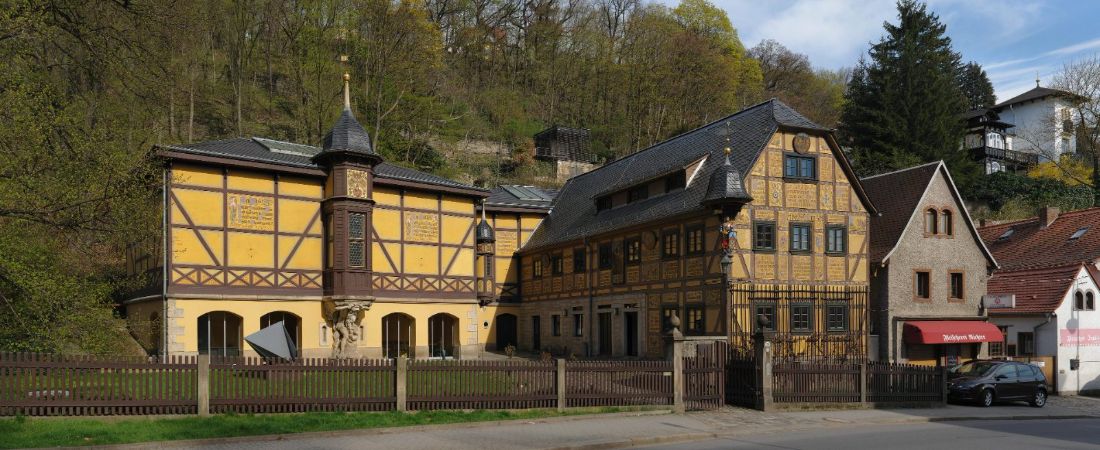
The building was a water mill, the lowest in the Loschwitzgrund, and was called Rothe Amsel. From 1785 to 1879 it belonged to the Hentschel family. The painter Eduard Leonhardi, 1828 to 1905, bought it in 1879 and converted it between 1882 and 1884 into a studio and exhibition house. His idea was a free artists' house for young artists without money.
Since 1991 the city of Dresden has run a gallery here. Exhibitions of contemporary art change roughly every six weeks, alongside a small selection of Leonhardi's own paintings. The building is a half-timbered structure with several bay windows, a curved canopy and figurative decoration by the painter Palmié.
Josef Hegenbarth Archive
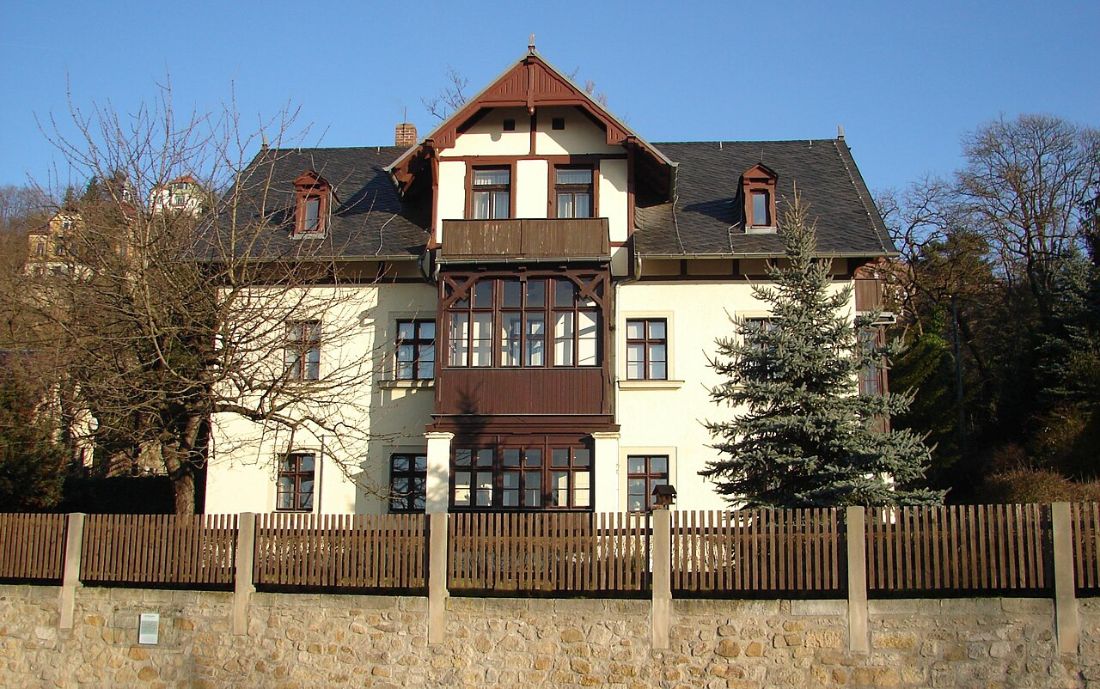
The building was erected as a vintner's house before 1839. The graphic artist and painter Josef Hegenbarth acquired it in 1921 together with a relative and moved into the second floor. He lived there until his death in 1962. His widow Johanna then founded the archive, and the museum opened after restoration in 1998.
The holdings comprise more than 13,700 works, 400 illustrated books, Hegenbarth's library, photographs and correspondence. The living and studio rooms have been reconstructed with the original furniture. It is run by the Kupferstich-Kabinett of the Dresden State Art Collections.
Schillerhäuschen
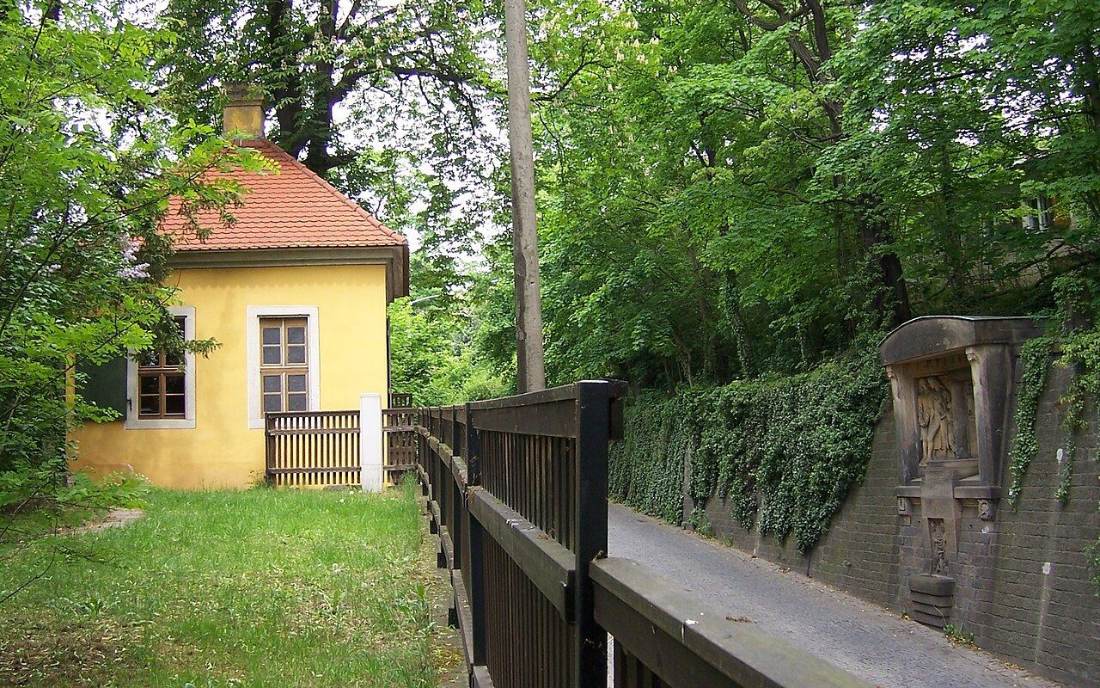
The garden house belonged to Christian Gottfried Körner's summer residence. Schiller spent two years in Dresden from September 1785 and returned once more in August and September 1801. Whether he wrote in the little house itself is not documented. Since it reopened in 2005 the Bürgerstiftung Dresden has looked after it on a voluntary basis, so opening hours are limited. It is worth checking current times before visiting.
Villas and their architects
The Loschwitz slope is a catalogue of villa architecture between 1880 and 1925. All the houses below are listed monuments and can be seen from the street. They are lived in; they are not museums.
| Building | Address | Year | Architect |
|---|---|---|---|
| Villa Silvana | Bautzner Landstraße 36 | 1881 | F. Richard Schaeffer |
| Villa Alpenruhe | Alpenstraße 7 | 1892, remodelled 1908 | Karl Reichpietsch |
| Fuchsbau | An der Berglehne 18 | 1893 | not recorded |
| Villa Malve | Steglichstraße 9 | 1905 to 1906 | Rudolf Kolbe |
| Villa Windhuk | Alpenstraße 14 | 1910 | Rose & Röhle |
| Residential house | Bautzner Landstraße 32 | 1912 | Max Herfurt |
| Villa | Schädestraße 2 | 1913 | Stephan and Möbius |
| Villa | Tolstoistraße 9 | 1924 | Carl Ernst Stephan |
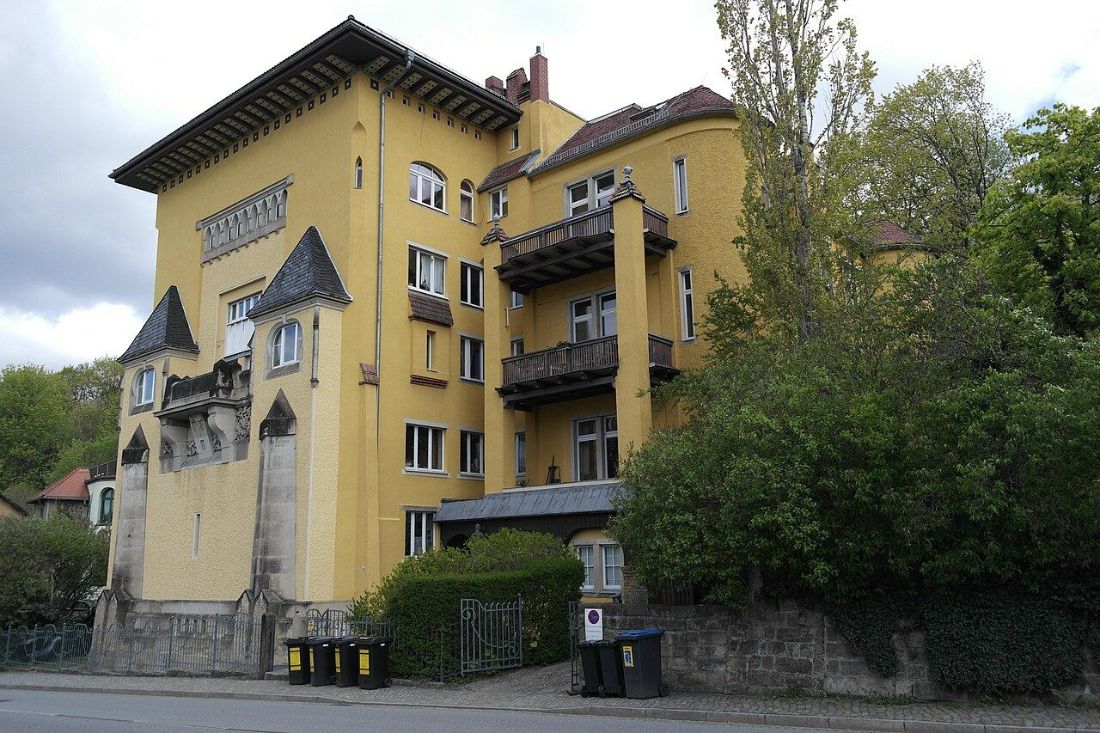
Rudolf Kolbe, who designed the Villa Malve, is best known for the Heilandskirche in Cotta. His Loschwitz building does almost without ornament and relies on proportion instead. Two generations earlier things looked different: the Villa Silvana of 1881 has three storeys, a tower annexe and plenty of sandstone and timber decoration.
The house at Tolstoistraße 9 has a history that appears in no architectural guide. Its owner was Dr Hans Meier, a senior civil servant. In 1933 he was expropriated as a Jew.
Places that are rarely mentioned
Once the standard destinations are ticked off, Loschwitz offers a second layer. The following places appear in guidebooks barely or not at all.
The Lingner mausoleum
Karl August Lingner, the manufacturer of Odol mouthwash, lies in a tomb designed by Hans Poelzig with sculpture by Georg Kolbe. Grey limestone, twelve Ionic half-columns, a rotunda quoting the ancient tholos temple while breaking it in expressionist fashion. Poelzig is the architect of the Großes Schauspielhaus in Berlin and the IG Farben building in Frankfurt. That one of his works stands on the Dresden Elbe slope is unknown even to many Dresdeners.

The observatory on the Plattleite
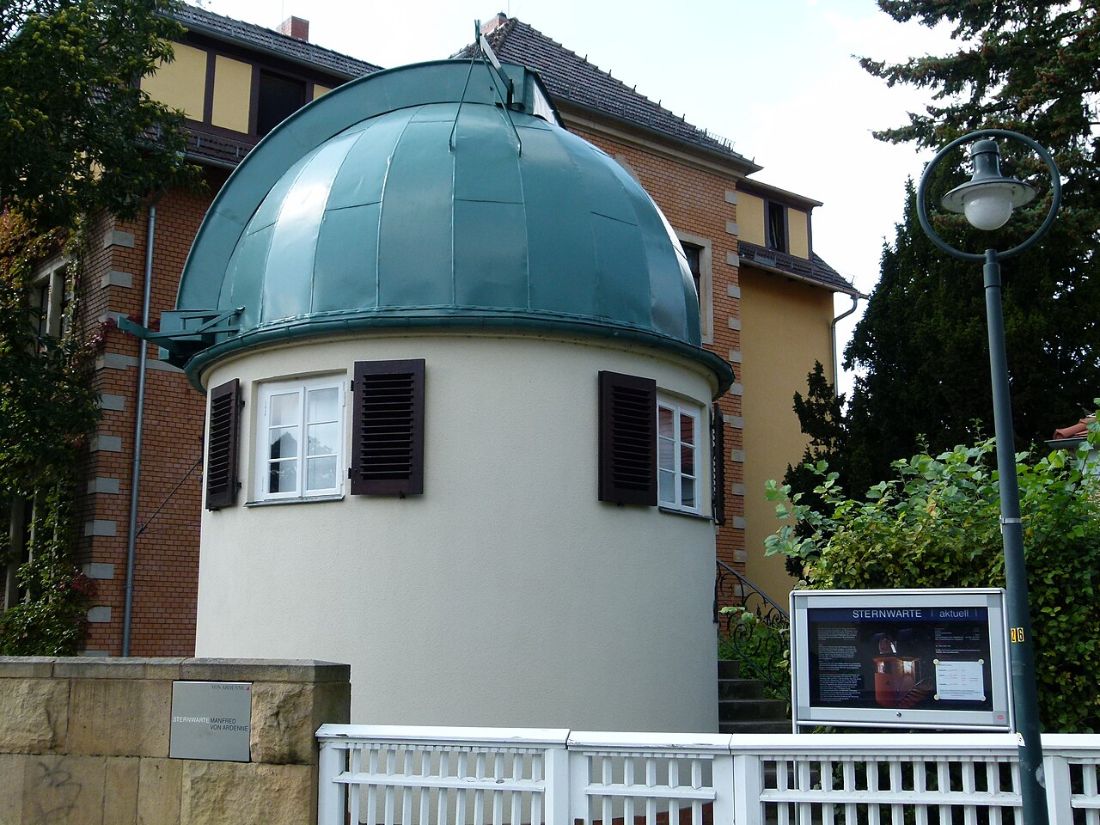
Manfred von Ardenne had it built. It houses a Zeiss refractor made between 1909 and 1911, with a 200-millimetre objective and a focal length of 3,000 millimetres. Only six of these instruments were ever made in Jena. In 2007 the installation received electronic stepper-motor control.
The old fire station tower with peregrine falcons
The tower of the old fire station is maintained by the Ortsverein Loschwitz-Wachwitz. A pair of peregrine falcons nests there and can be watched via a live camera. A nesting site in the middle of the district that is easy to miss from the ground.
The Ortsverein streams the nesting site in the fire station tower via YouTube. The video only loads when you start it, and doing so transfers data to YouTube.
The churchyard at the Loschwitz church
Not to be confused with the large cemetery on Pillnitzer Landstraße. The churchyard right beside the building is one of the smallest surviving eighteenth-century churchyards in Saxony. Loschwitz residents were buried here for as long as there was space.
The cemetery chapel of 1893
Designed by the Reuter & Fischer practice. The stained glass was created by Wilhelm Walther, who also made the Fürstenzug on the Dresden palace wall. A crucifixion scene was contributed by Johannes Hartmann. The bell was cast by Friedrich Wilhelm Schilling in 1947 and carries the inscription "Frieden" (peace).
The memorial stone for Ludwig Richter
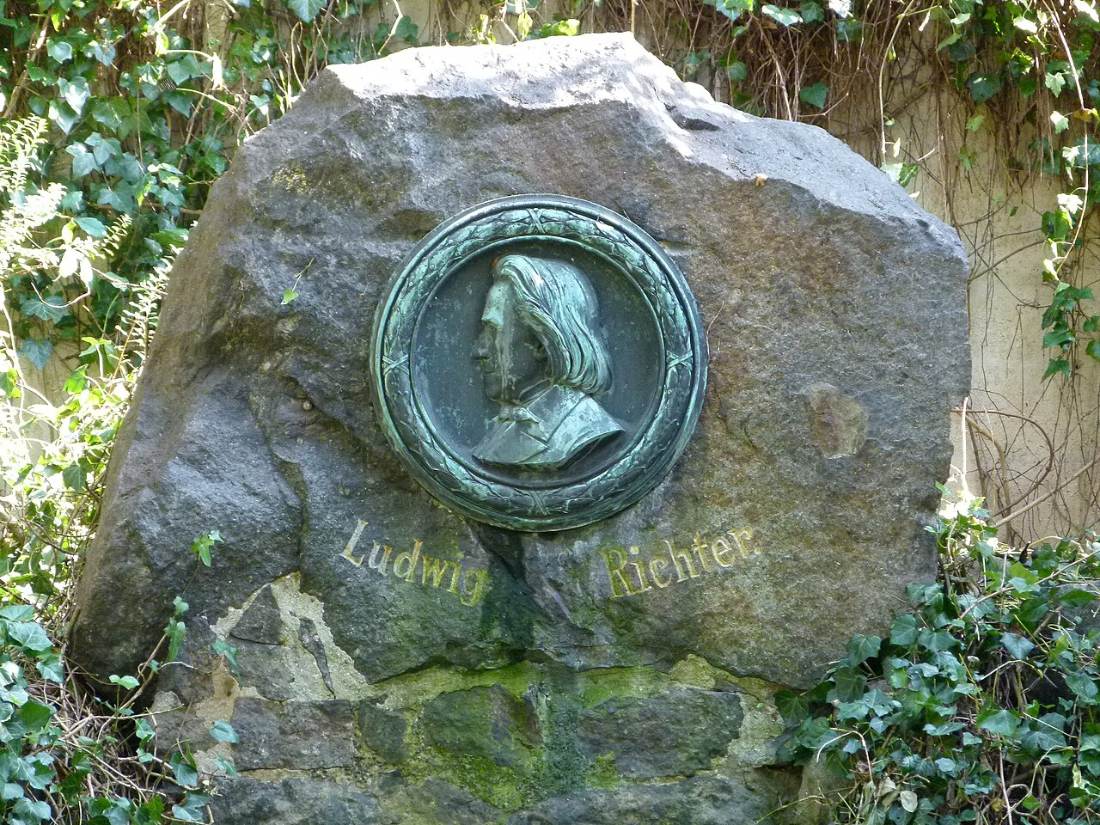
Eduard Leonhardi had it set up during the painter's lifetime. The stone has stood on the grounds in the Loschwitzgrund since 1884. Incidentally, a population of about 25 wall lizards lives there, counted in 2022.
Prinzeß Louisa tunnel and trestle viaduct
The 547-metre funicular line runs through the 96-metre Burgberg tunnel, across a 102-metre trestle viaduct with the passing loop, and then through the 54-metre Prinzeß Louisa tunnel. The viaduct can be viewed from the footpath without taking the ride. The structures date from before 1895.
Malerstraße 31, 32 and 34
Owned by the Grahl family since 1865 and, since 1997, the seat of the Archiconvent of the Templars. One of the quieter corners of Loschwitz, the kind you walk past without looking.
The artists' graves in the Loschwitz cemetery
More than a hundred artists lie here, among them the painters Sascha Schneider, 1870 to 1927, and Oskar Zwintscher, 1870 to 1916, and the sculptor Friedrich Press, 1904 to 1990. Around 80 graves are protected as individual monuments, the cemetery as a whole since 1985. The grounds include a new section laid out in 1918 and an urn grove completed in 1927. The site was flooded in 2002 and 2013.
The Loschwitzgrund valley and its brook
Grundstraße follows a brook few people know, although it gave the district its shape. The Loschwitzbach, locally also called the Trille, rises in Bühlau on the edge of the Dresdner Heide forest and flows some five kilometres south-west until it reaches the Elbe near the Blaues Wunder. Its catchment covers 5.2 square kilometres and is fed by thirteen springs.
Seven mills worked on this brook, from the Middle Ages into the industrial era. The Lohmühle, Bärmühle and Zeibigmühle were among them; most were demolished or converted. The Hentschel mill still stands and is now the Leonhardi Museum. Little is left of the brook itself: it is culverted along long stretches, embanked on both sides, and visible in the open for only about 300 metres at the Loschwitz meadows.
The Mordgrund bridge
The name sounds like legend, but the bridge is above all a piece of transport history. A crossing existed at this spot as early as 1420; the present stone arch bridge dates from 1828. Master mason Donath carried out the work; it was eleven ells wide, a good 6.2 metres, and cost 3,000 thalers. The arch narrows in steps towards the upstream side.
The bridge marks the transition from Bautzner Straße to Bautzner Landstraße and lay on the trade route between Silesia and Dresden. It was guarded by the Napoleonschanze redoubt, built in 1758 and 1760. It is a listed monument and considered significant for the history of technology and transport. Anyone driving the B6 crosses it without noticing.
The Künstlerhaus on Pillnitzer Landstraße
Martin Pietzsch, 1866 to 1961, planned and built it himself. It was finished in spring 1898 after a year of construction, on the grounds of the former Unger vineyard. In 1904 a fire badly damaged the house; rebuilding lasted until 1906 and produced its present form. In 1900 the Small Künstlerhaus was added as Pietzsch's own home.
Sixteen studios and workrooms, plus twelve flats. More than sixty artists have worked there, among them Max Pietschmann, Sascha Schneider, Hermann Glöckner and Georg Müller-Breslau. In 1972 the house passed to the city; in 1992 it returned to the family and was restored. Architecturally it mixes Italian echoes with Jugendstil and Secession, recognisable in the projecting flat roof and the tall studio windows.
Questions about the sights
Do the Elbe castles belong to Loschwitz?
Yes. Schloss Albrechtsberg, Lingner Castle and Schloss Eckberg stand on Bautzner Straße on the right bank of the Elbe in the Loschwitz district. The Saloppe water works lies in the Loschwitz cadastral district but is counted statistically as part of the Radeberger Vorstadt.
Can you visit the Loschwitz church?
The church is an active parish church with services and concerts. Opening hours for visits change seasonally; a look at the parish website before setting out saves a wasted trip.
What does admission to the three museums cost?
The houses have different operators and different prices. The Leonhardi Museum belongs to the city, the Josef Hegenbarth Archive to the State Art Collections, and the Schillerhäuschen is run by volunteers. Please check prices and times with each house directly.
Can the villas be visited inside?
No. They are inhabited private houses. Many are clearly visible from the street, especially on Alpenstraße and An der Berglehne.
Where is the Lingner mausoleum?
At Bautzner Straße 132, on the grounds around Lingner Castle above the Elbe.
What is worth seeing if time is short?
Two hours are enough for Körnerplatz, the church, a ride on one hill railway and the view from the top. If you add the Loschwitzgrund valley and the Leonhardi Museum, allow half a day.