Dresden Loschwitz
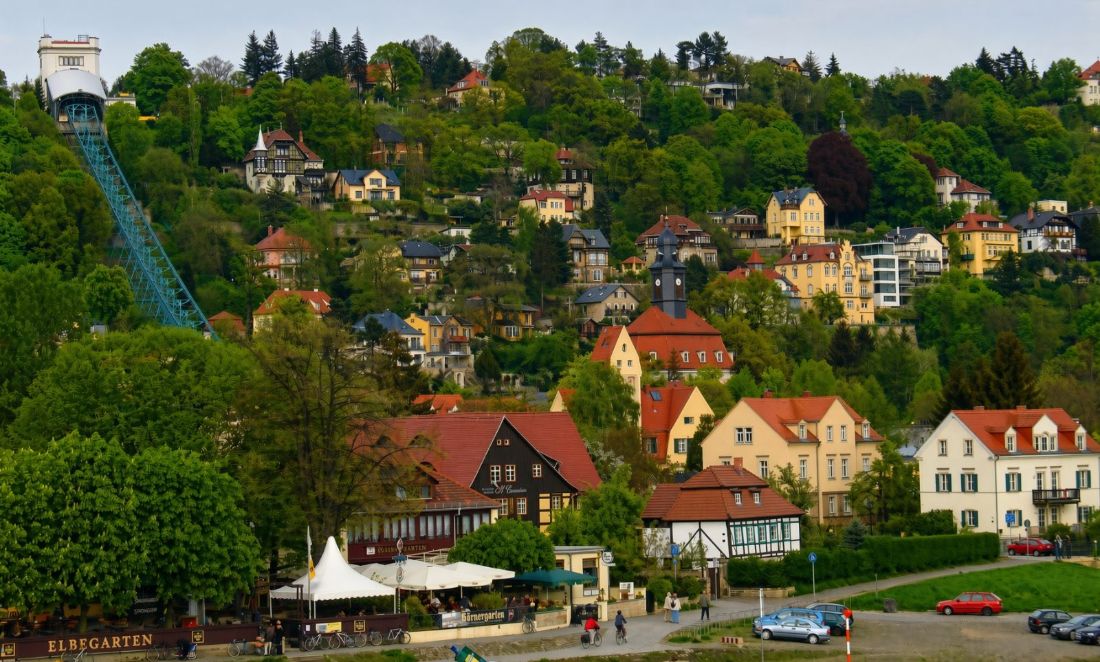
Loschwitz lies on the right bank of the Elbe in the east of Dresden, between 107 and 260 metres above sea level. The district has belonged to the city since 21 January 1921, it has its own church by George Bähr, two hill railways from the imperial era and a slope full of villas whose architects appear in no guidebook. This site collects what can be documented about Loschwitz.
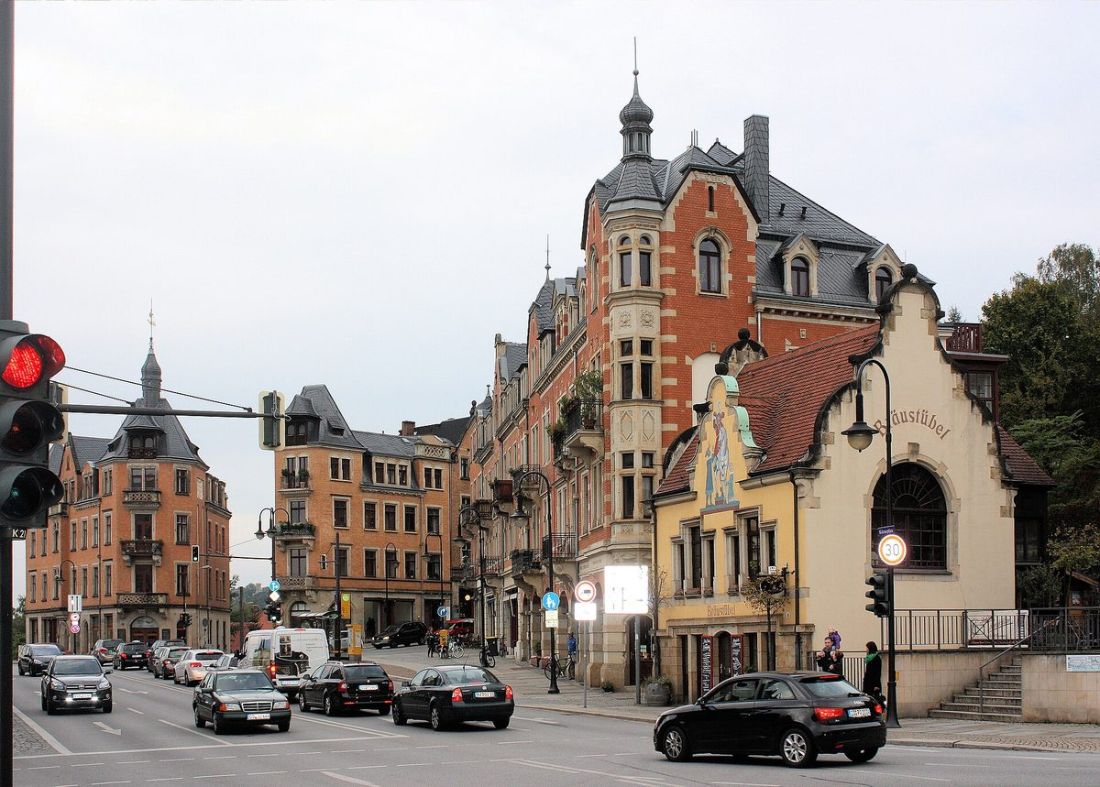
Anyone crossing the Blaues Wunder (the "blue wonder", the Loschwitz bridge) arrives directly at Körnerplatz. From there the route continues in three directions: up Grundstraße into the Loschwitzgrund valley, along Pillnitzer Landstraße upriver towards Wachwitz, and straight up the slope on the two hill railways. This layout explains almost everything about the place. Loschwitz is a village at the foot of a steep hillside that wealthy Dresden residents discovered and built over in the nineteenth century, without the old village structure disappearing entirely.
The key figures
| Location | right bank of the Elbe, eastern Dresden |
|---|---|
| Elevation | 107 to 260 metres above sea level |
| Postcode | 01326 |
| Dialling code | 0351 |
| First documentary mention | 1315; the city celebrated the 700th anniversary in 2015 |
| Incorporation into Dresden | 21 January 1921 |
| Neighbouring districts | Radeberger Vorstadt, Weißer Hirsch, Bühlau, Rochwitz, Wachwitz, Dresdner Heide |
| Opposite bank | Blasewitz, connected by the Blaues Wunder bridge |
A wine village that stopped being one
Wine was grown on the Loschwitz slope as early as the eleventh century, recorded in connection with Benno of Meissen. For centuries vineyards, press houses and vintners' cottages shaped the place. From around 1850 the decline set in, and in 1885 phylloxera arrived. It ended viticulture in Loschwitz for roughly a hundred years.
The end of the vineyards freed the hillside for something else. Where vines had stood, villas with terraced gardens, retaining walls and lookout turrets went up from the 1870s onwards. Some of the vineyard houses survived and were put to new use. The Josef Hegenbarth Archive occupies a vintner's house built before 1839. The Künstlerhaus (artists' house) at Pillnitzer Landstraße 59 stands on the grounds of the former Unger vineyard.
Organised viticulture returned in 1987. The Weinbaugemeinschaft Loschwitz/Wachwitz (Loschwitz/Wachwitz winegrowers' association) was founded on 17 June 1987 with 38 members, after the first clearing work had begun in the summer of 1986. Some members tend plots at Lingner Castle.
What Loschwitz has to offer
-
Two hill railways
The funicular has run since 26 October 1895, the suspension railway since 6 May 1901. The latter is considered the oldest mountain suspension railway in the world.
-
George Bähr's church
Consecrated on 3 August 1708, destroyed in February 1945, reconsecrated on 2 October 1994. An octagonal baroque building in old rose.
-
Three museums
The Leonhardi Museum, the Josef Hegenbarth Archive and the Schillerhäuschen are all in the district. None of them is large, all three are worth the visit.
-
Villas on the slope
Around Alpenstraße, Steglichstraße and An der Berglehne stand buildings by Rudolf Kolbe, Martin Pietzsch and Karl Reichpietsch.
The district has several parts
The local chronicle distinguishes the village centre, Auf der Platte in a western and an eastern section, Oberloschwitz, Schöne Aussicht and the Simmig quarter. This division is not an administrative construct but topography. Down by the water lies the old village core with the church, Körnerplatz and Friedrich-Wieck-Straße. Above the crest of the slope begins Oberloschwitz with the upper station of the suspension railway.
Almost a hundred metres of altitude separate the two levels. Anyone climbing them on foot quickly understands why two railway companies took on this slope in 1895 and 1901. The gradient of the suspension railway reaches 39.9 per cent in places.
Famous names, briefly sorted
Christian Gottfried Körner had a summer residence in Loschwitz. Friedrich Schiller first came to Dresden on 11 September 1785 and stayed two years. Whether the "Ode to Joy" was actually written in the garden house on today's Schillerstraße cannot be proven. All that is documented is that Schiller worked in the main house and in the town flat. Körner later also received Mozart, in 1789, and Goethe, in 1790.
The painter Josef Hegenbarth lived on Pillnitzer Landstraße from 1921 and died there in 1962. The painter Eduard Leonhardi bought the old Hentschel mill in the Loschwitzgrund valley in 1879 and converted it into a studio. The architect Martin Pietzsch completed the Künstlerhaus in 1898; more than sixty artists have worked in it since, among them Sascha Schneider and Hermann Glöckner. Heinrich Schütz, Gerhard von Kügelgen and Peter Schreier are also associated with the district.
Frequently asked questions about Loschwitz
When was Loschwitz incorporated into Dresden?
On 21 January 1921, and against considerable resistance from residents. Before that Loschwitz was an independent municipality.
How do you get from Blasewitz to Loschwitz?
Across the Blaues Wunder bridge on foot, by bike, by bus or by car. A ferry also runs in summer. Details are on the travel page.
Which hill railway is which?
The funicular runs on rails in the ground up to the Luisenhof, the suspension railway hangs from a steel frame and ends in Oberloschwitz. Both start within walking distance of Körnerplatz and both belong to the Dresden transport company.
Is wine still grown in Loschwitz?
Yes, but on a small scale. The Loschwitz/Wachwitz winegrowers' association tends plots at Lingner Castle among others. Six of its members have their vines in Loschwitz.
When does the Elbhangfest take place?
On the last weekend in June, along the stretch between the Blaues Wunder bridge and Pillnitz Castle. At its peak the festival drew around 80,000 visitors.
Is Loschwitz the same as Weißer Hirsch?
No. Weißer Hirsch is a separate district above Loschwitz and was the spa resort of the area. Both belong to the Loschwitz city district, which regularly causes confusion.